Showing posts with label I highly recommend this. Show all posts

Tuesday, December 30, 2025

Five Star Reads of 2025

Here are the books I read in 2025 that I gave five stars to. I know it bothers Sarah endlessly that most of these were not published in 2025, but I'm not sure why she doesn't want to know that I found a book from 1952 to be excellent. 

I had thirteen five star reads this year. Last year I had nineteen, but I reread a bunch of Harry Potter and I read some fabulous Ken Follett books, so it's hardly a fair comparison. I guess there's a slight chance I'll read another five star book in the next two days, but that's not looking likely, to be honest.

*****************

Gone With the Wind by Margaret Mitchell (I had a three part review because how else do you talk about this masterpiece?) - What can I say? This book is absolutely wonderful. There's so much to talk about when you talk about this book, but all I can say is that Mitchell made me care about truly horrible people and that's something special. 

The Third Gilmore Girl by Kelly Bishop - What a life Bishop has had. I listened to the audiobook and she narrated it, which was fun. 

The Three Lives of Cate Kay by Kate Fagan - This book had some tropes I normally don't like, but I loved every second of this book. 

Back After This by Linda Holmes - Holmes knows how to write a romance that appeals to me. 


Ministry of Time by Kalianne Bradley - This was a book I read for my IRL book club and I was surprised at how much I enjoyed it. 

How to Read a Book by Monica Wood - Maybe it's a bit sentimental, but this book about second chances and found family really hit the mark for me. 

The Favorites by Layne Fargo - A sports book I could not put down! Not too much sport in this. 

Night Film Marisha Pessl - I still think about this mixed media book. Super fun to do the investigation on my own. 

Feed by Mira Grant - Zombies! Bloggers! What more could I ask for? 

The Correspondent by Virginia Evans - I am just like everybody else. I love Sybil.

Mr. President, How Long Must We Wait? by Tina Cassidy - We named our new car Lucy after Lucy Burns. 

Charlotte's Web by E.B. White - There really is a reason everyone reads this in elementary school. What a lovely book.

When the Cranes Fly South by Lisa Ridzén - Do you want a good cry? This is a good option!

*****************

I had another ten 4.5 star reads. 

The Blue Castle L.M. Montgomery
Crow Mary by Kathleen Grissom
Here Be Dragons by Sharon Kay Penman
Blackout by Dhonielle Clayton, Tiffany D. Jackson, Nic Stone, Angie Thomas, Ashley Woodfolk, and Nicola Yoon
I Who Have Never Known Men by Jacqueline Harpman, translated by Ros Schwartz
The Dream Hotel by Laila Lalami
Kate & Frida by Kim Fay
Heartwood by Amity Gaige
How to Read Literature Like A Professor by Thomas C. Foster
Her Many Faces by Nicci Cloke

*****************

Have you read any of these books? What was your #1 book of 2025?

Thursday, January 30, 2025

Gone with the Wind by Margaret Mitchell (Part III of the review)

 Part I here and Part II here


Okay, so let's get real about some of the criticisms of the book. I've tried to remain mostly spoiler free in these reviews. but I'm going to talk about plot points in this post. 

There are a number of legitimate criticisms of the book. The first is obviously its portrayal of black people, frequently describing them as non-human, stupid, or incapable. There are lines in the book about how all the slaves at Tara (Scarlett's family plantation) and Twelve Oakes (Ashley's family plantation) were happy. The use of the n-word abounds. The treatment of Prissy and Mammy, even after they were freed, is abhorrent. 

I think this is all fair criticism. I also think it's an important artifact of its time. I am not dismissing the racism of the book. This was how Mitchell was writing about the 1860s in the 1930s. The novel is Scarlett's perspective and Scarlett is a very imperfect character and only really concerned herself with things for her own comfort and perspective. To her, all the stereotypes of black people may have seemed true, although how she could think black people were stupid when Mammy was in her life is puzzling. But that's the point, isn't it? Scarlett is not reflective about other people at all. She even admits in the end chapters that she never understood Rhett or Ashley. If she never stopped to really think about the most important men in her life, why would she bother to think about things like slavery? Scarlett literally thought the Civil War was not a big deal at the beginning of the novel. 

So, yes, there's racism. I think it's important to read books that show us that side of American history. It's important to hear and see it and think about how things are different and how things are the same. If you are a sensitive reader, this might not be the book for you. 

Another big criticism is the glorification of white supremacy and the romanticism of the Confederacy. It's not a Confederate soldier who nearly rapes Scarlett - it's a Yankee. It's not the Confederate soldiers who use Tara as a way station after the war that causes such money issues for Scarlett - it's the Yankees. The Confederates may have lost the war, but they were in the right.

In the context of the book, though, of course that's what Scarlett thought. She doesn't read books, she doesn't care about current events, and she's solely influenced by the people around her. If they all think this, why wouldn't she? Why would anyone expect any different? Also, as J pointed out in a comment on this post, Scarlett sees through some of it. She thinks the war is wrong, people are dying for principles, and that the cause is not worth the effects of the war on everyone from soldiers to civilians. 

For people who say this is Confederate propaganda, I have to say that they must be reading a different book than I am. It actually seems like an anti-war book to me full stop. There is definitely a feeling of romanticizing the plantation life in the antebellum period, particularly early on in the novel, but if you read the entire book and still feel that way, that says more about you and your own values than it does about the words in the book, full of descriptions of the terrible impacts of war on soldiers and civilians alike, property destruction, and ruin of community and that's before you get into the chaos and fear of the post-war period. 

Okay, let's move on to the Ku Klux Klan. Scarlett is vehemently against the organization because she thinks it's unnecessarily dangerous. She thinks that KKK members are fools. Her second husband kept his membership a secret from her (as did Melanie, Ashley, and India) because he knew she wouldn't approve. I actually read the book as vehemently anti-KKK and was surprised to see that  a criticism of the book was that it supported the KKK. Sure, Scarlett wasn't against it because she cared about black people, but she wasn't for it. I actually think it's to the book's credit that it addressed the KKK in this way. It would have read like Mitchell was nervous to address it head on if she'd left it out.

Yes, Mitchell was writing to encourage people to feel sympathy for the Confederacy. That still has impacts today. But if you read the book, as a truly thinking person, while you may feel badly for some of the characters, they're also all pretty terrible, so I didn't feel terrible for any of them. *shrug* Your mileage may vary on that. 

I feel a bit that I am going to come off as a Confederate sympathizer with this review. I am not. I don't actually think the book makes it seem like the Confederates were the good guys. I think a lot of the strongest defenders of slavery come from characters were are absolute idiots - in Chapter 57, Scarlett and Ashley have a quarrel over using convict labor at the sawmill and this happens:

“I’m not afraid of what people say as long as I am right. And I have never felt that convict labor was right.” [This is Ashley.]
“But why — ”  [This is Scarlett.]
“I can’t make money from the enforced labor and misery of others.”
“But you owned slaves!”
“They weren’t miserable..."

Scarlett is a selfish insufferable human who thinks using convict labor is better than using freed slaves for stereotypical reasons and Ashley says his slaves weren't miserable. But Ashley's an idiot. He is a member of the KKK. I don't actually read this passage as saying slavery was good. *shrug* It's all in your lens, I guess. (I do read it as convict labor is okay, which is wrong on another level, but Scarlett is portrayed as willing to do just about anything to make money, so I take that with a grain of salt.)

Let's talk about Margaret Mitchell. She was born in 1900, decades after the end of the Civil War. She was a journalist and Gone with the Wind is her one and only novel. Imagine writing ONE book and it's THIS ONE. Her grandfathers were both in the Confederate Army and didn't learn that the Confederates didn't win the Civil War until she was ten. She heard stories about the Civil War from family members growing up. One of her mentors was Thomas Dixon, Jr., a charming (/s) man who supported eugenics and the Lost Cause of the Confederacy. I've no doubt that Margaret Mitchell would not be a good hang and that she did intend for this book to be read as indeed romanticizing the Confederate cause. But the author's intention is not always how the reader interprets and that's the case for me while I was reading this book. 

Anyway. This book is a masterpiece. It raises so many interesting questions (most especially how does Mitchell write characters who are so terrible and yet so compelling) on so many topics and I find it remarkable, especially considering that it was a debut novel. Feel free to come at me in the comments. What do I have wrong here?

Wednesday, January 29, 2025

Gone with the Wind by Margaret Mitchell (Part II of the review)

I listened to the audiobook, but I took page numbers are from this Archive edition. Part I of my review is here. 

The copy I borrowed from the library. It was too big to be comfortable to hold, but I loved the audiobook, so I'm happy that's the direction I went in. 

Lines of note:

“Oh, Pa,” cried Scarlett impatiently, “if I married him, I'd change all that!”
“Oh, you would, would you now?” said Gerald testily, shooting a sharp look at her. “Then it's little enough you arc knowing of any man living, let alone Ashley. No wife has ever changed a husband one whit, and don’t you be forgetting that..." (page 35)
Gerald might be the best character in the whole book. It's too bad he owned slaves or I would suggest he was actually a good man. 

The library was in semidarkness, for the blinds had been drawn against the sun. The dim room with towering walls completely filled with dark books depressed her. It was not the place which she would have chosen for a tryst such as she hoped this one would be. Large numbers of books always depressed her, as did people who liked to read large numbers of books. (page 113-114)
This is why I'm not friends with Scarlett. Books shouldn't depress you! They should give you life. Scarlett's lack of intellectual curiosity is one of the most interesting aspects of her personality. She's not even embarrassed about it. 

“I have always thought,” he said reflectively, “that the system of mourning, of immuring women in crepe for the rest of their lives and forbidding them normal enjoyment is just as barbarous as the Hindu suttee.”
“Settee?”
He laughed and she blushed for her ignorance. She hated people who used words unknown to her.
“In India, when a man dies he is burned, instead of buried, and his wife always climbs on the funeral pyre and is burned with him.”
“How dreadful! Why do they do it? Don’t the police do anything about it?"
“Of course not. A wife who didn’t burn herself would be a social outcast. All the worthy Hindu matrons would talk about her for not behaving as a well-bred lady should — precisely as those worthy matrons in the corner would talk about you, should you appear tonight in a red dress and lead a reel. Personally, I think suttee much more merciful than our charming Southern custom of burying widows alive!”
“How dare you say I’m buried alive!”
“How closely women clutch the very chains that bind them! You think the Hindu custom barbarous — but would you have had the courage to appear here tonight if the Confederacy hadn’t needed you?” (page 182-183)
Even though Scarlett knows she's ignorant, she doesn't actually do anything to rectify it. She just blames the other person. Crazy!

“Money can't buy everything.”
"Someone must have told you that. You'd never think of such a platitude all by yourself. What can’t it buy?”
"Oh, well, I don’t know — not happiness or love, anyway.”
"Generally it can. And when it can’t, it can buy some of the most remarkable substitutes.” (page 193)
It certainly can buy you a level of comfort, that can't be denied. 

It was not often that she was alone like this and she did not like it. When she was alone she had to think and, these days, thoughts were not so pleasant. Like everyone else, she had fallen into the habit of thinking of the past, the dead. (page 335)
I sort of feel for Scarlett here. I also do not like to be left alone with my thoughts. 

"I’d back you against the Yankees any day.”
“I’m not sure that that’s a compliment,” she said uncertainly.
“It isn’t,” he answered. “When will you stop looking for compliments in men’s lightest utterances?” (page 336)
I snorted laughing at this line. Captain Butler is a rascal. 

Was Tara still standing? Or was Tara also gone with the wind which had swept through Georgia? (page 397) - A sighting of the book title in the text!!!

It was beyond her comprehension that anyone could love Suellen. Her sister seemed to her a monster of selfishness, of complaints and of what she could only described as pure cussedness. (page 485)
I felt this line in my soul. 

“Girls have to marry someone.”
“Indeed, they do not,” said Pitty, ruffling. "I never had to.” (page 561)
Ah, this was such an awkward scene. Pitty has to rely on the kindness of her family to survive in the world as an older person who never married. Scarlett and Melanie know this, but are too kind to say it to her. 

It had begun to dawn on him that this same sweet pretty little head was a “good head for figures.” In fact, a much better one than his own and the knowledge was disquieting. He was thunderstruck to discover that she could swiftly add a long column of figures in her head when he needed a pencil and paper for more than three figures. And fractions presented no difficulties to her at all. He felt there was something unbecoming about a woman understanding fractions and business matters and he believed that, should a woman be so unfortunate as to have such unladylike comprehension, she should pretend not to. Now he disliked talking business with her as much as he had enjoyed it before they were married. Then he had thought it all beyond her mental grasp and it had been pleasant to explain things to her. Now he saw that she understood entirely too well and he felt the usual masculine indignation at the duplicity of women. Added to it was the usual masculine disillusionment in discovering that a woman has a brain. (page 616)
Ah, well. It's 2025. Girls and women sometimes still have to hide their smarts, don't they?

“There’s more ways of killing a cat than choking him to death with butter,” giggled Melanie when the whiskered old man had thumped down the stairs. (page 917)
What is this idiom? Why are cats involved?

"...I’m sorry because you are such a fool you don’t know there can’t ever be happiness except when like mates like..." (page 939)
Big discussion in our house around this one. Should like mate like or do opposites attract? Or maybe it's both? Maybe we are most attracted to those who we shouldn't be with?

Pitty, who desired nothing except to live comfortably amid the love of her relatives, would have been very pleased, in this matter, to run with the hares and hunt with the hounds. But neither the hares nor the hounds would permit this. (page 953)
More idioms I've never heard!

He drew a short breath and said lightly but softly: "my dear, I don’t give a damn." (page 1035)
Famous line from the film!!!

Things I looked up: 

Battle of the Boyne (page 42) - took place in 1690 between the forces of the deposed King James II, and those of King William III who, with his wife Queen Mary II (his cousin and James's daughter), had acceded to the Crowns of England and Scotland in 1689. The battle was fought across the River Boyne close to the town of Drogheda in the Kingdom of Ireland, modern-day Republic of Ireland, and resulted in a victory for William. This turned the tide in James's failed attempt to regain the British crown and ultimately aided in ensuring the continued Protestant ascendancy in Ireland.

St. Simons Island (page 45) - an island off the Georgia coast known for its salt marshes and sandy stretches

Zouave (Chapter 9) - a class of light infantry regiments of the French Army serving between 1830 and 1962 and linked to French North Africa. The zouaves were among the most decorated units of the French Army. With the outbreak of the Civil War, many zouave units were raised on both sides. Louisiana, with its French culture and traditions raised the majority of Zouave units for the Confederacy. Zouave units, North and South, served with distinction at Antietam and throughout the Civil War. 

passementerie (page 232) - the art of making elaborate trimmings or edgings (in French, passements) of applied braid, gold or silver cord, embroidery, colored silk, or beads for clothing or furnishings

tumbrils (page 242) - an open cart that tilted backward to empty out its load, in particular one used to convey condemned prisoners to the guillotine during the French Revolution

Florida water (page 244) - an American version of an Eau de Cologne. Like European eau de colognes it is a citric scent, but shifts the emphasis towards sweet orange (rather than the bergamote orange, lemon and neroli of 4711) and adds spicy notes like clove. The name refers to the fabled Fountain of Youth, which is said to be located in Florida, as well as the "floral" nature of the scent.

Jeb Stuart (page 267) - a Confederate army general and cavalry officer during the American Civil War

Portrait by George S. Cook, 1863 - The point in the book was his beard.

Nathan Bedford Forrest (page 267) - a 19th-century American slave trader active in the lower Mississippi River valley, a Confederate States Army general during the American Civil War, and the first Grand Wizard of the Reconstruction-era Ku Klux Klan, serving from 1867 to 1869

Another beard reference

A pagan hearing the lapping of the waters around Charon’s boat could not have felt more desolate. (page 276) - Ha ha. I heard this as Karen's boat and could not figure out what was happening. Obviously Charon was the ferryman of the underworld. It all made sense when I saw it written out. 

For even as Andersonville was a name that stank in the North, so was Rock Island one to bring terror to the heart of any Southerner who had relatives imprisoned there.(page 285-286) - I cannot tell if this is Mitchell's pro-South bias. It seems like the consensus is that there was overcrowding at the prison, but that Mitchell's claims were overblown about conditions and deaths. 

“Mr. Lincoln, the merciful and just, who cries large tears over Mrs. Bixby’s five boys, hasn’t any tears to shed about the thousands of Yankees dying at Andersonville,” said Rhett, his mouth twisting. “He doesn’t care if they all die. The order is out. No exchanges. (page 286) 

The Bixby letter is a brief, consoling message sent by President Abraham Lincoln in November 1864 to Lydia Parker Bixby, a widow living in Boston, Massachusetts, who was thought to have lost five sons in the Union Army during the American Civil War. Along with the Gettysburg Address and his second inaugural address, the letter has been praised as one of Lincoln's finest written works and is often reproduced in memorials, media, and print.

Lucullan banquet (page 294) - adj., (especially of food) extremely luxurious

Thermopylae (page 296) - The Battle of Thermopylae was fought over three days in 480 BC between the Achaemenid Persian Empire under Xerxes I and an alliance of Greek city-states led by Sparta under Leonidas I.  The Persian victory at Thermopylae allowed for Xerxes' passage into southern Greece, which expanded the Persian empire even further. Today the Battle of Thermopylae is celebrated as an example of heroic persistence against seemingly impossible odds

vermifuge (page 430) - a medicine used to destroy parasitic worms

Gorterdammerung (page 527)  - a collapse (as of a society or regime) marked by catastrophic violence and disorder

Hat mentions:

waving their hats (page 10-11)

 wide Panama hat (page 25, 261, 336, 378, 960)

“You keep yo’ shawl on yo’ shoulders w’en you is in de sun, an’ doan you go takin’ off yo’ hat w’en you is wahm,” she commanded...(page 78)

hat in hand (page 81, 381, 919, 931)

took off his hat with a sweep (page 84)

Today, dressed in dull black silk over unfashionably narrow hoops, she still looked as though in her habit, for the dress was as severely tailored as her riding costume and the small black hat with its long black plume perched over one warm, twinkling, brown eye was a replica of the battered old hat she used for hunting. (page 85)

They were a pretty, buxom quartette, so crammed into the carriage that their hoops and flounces overlapped and their parasols nudged and bumped together above their wide leghorn sun hats, crowned with roses and dangling with black velvet chin ribbons. All shades of red hair were represented beneath these hats, Hetty’s plain red hair, Camilla’s strawberry blonde, Randa’s coppery auburn and small Betsy’s carrot top.

"And looks a lot like Hetty, too,” said Camilla, and then disappeared shrieking amid a welter of skirts and pantalets and bobbing hats, as Hetty, who did have a long face, began pinching her. (page 88)

“That’s a fine woman,” said Gerald, putting on his hat and taking his place beside his own carriage. (page 91)

yellow hat with long cherry streamers (page 102)

"...But you, my dear Miss O’Hara, are a girl of rare spirit, very admirable spirit, and I take off my hat to you." (page 120)

The Munroe boys tore past waving their hats, and the Fontaines and Calverts went down the road yelling. (page 127)

His hat was gone...(page 205)

He walked out into the dim hall and picked up the hat he had dropped on the doorsill. (page 205)

his hat in his hand (page 231, 317)

Just at this moment, nothing mattered to her except that she looked utterly charming in the first pretty hat she had put on her head in two years. What she couldn’t do with this hat! (page 243)

In a moment the hat was back in its box. (page 243)

“And turn it into a fright like your other hats? No.” (page 243)

raised his hat (page 257)

laying down his hat and bag (page 262)

But she wanted to give him something more personal, something a wife could give a husband, a shirt, a pair of gauntlets, a hat.  Oh, yes, a hat by all means... But the only hats obtainable in Atlanta were crudely made wool hats, and they were tackier than the monkey-hat forage caps. (page 269)

When she thought of hats, she thought of Rhett Butler. He had so many hats, wide Panamas for summer, tall beavers for formal occasions, hunting hats, slouch hats of tan and black arid blue. (page 269)

She paused and thought it might be difficult to get the hat without some explanation. She simply could not tell Rhett she wanted it for Ashley. He would raise his brows in that nasty way he always had when she even mentioned Ashley’s name and, like as not, would refuse to give her the hat. (page 269)

wide felt hat (page 276)

dropped the hat (page 276)

retrieve his hat (page 277)

...his hat bravely pinned up on one side. (page 314)

He picked up his hat ...(page 342, 971)

tattered gray hat (page 359)

He gathered the reins again and put on his hat. (page 359)

The shadow seemed to take off a hat and a quiet voice came from the darkness. (page 371)

he removed his hat (page 378)

They were all ragged, so ragged that between officers and men there were no distinguishing insignia except here and there a torn hat brim pinned up with a wreathed “C.S.A.” (page 385)

Why hadn’t she brought her sun hat? (page 396)

without a hat  (page 397, 997)

He should come home on a prancing horse, dressed in fine clothes and shining boots, a plume in his hat. (page 502)

And what a cunning hat! Bonnets must be out of style, for this hat was only an absurd flat red velvet affair, perched on the top of the woman’s head like a stiffened pancake. The ribbons did not tie under the chin as bonnet ribbons tied but in the back under the massive bunch of curls which fell from the rear of the hat... (page 537)

pancake hat (page 544, 661)

fine fur hat (page 556)

tall hat (page 621) 

"...My horse is nearly dead — all the way up here at a dead run — and like a fool I went out of the house today a bat out of hell without a coat or hat or a cent of money..." (page 645)

battered straw hat (page 691)

beatin’ the horse with his hat (page 702)

Feet were stilled, hats were removed, hands folded and skirts rustled into quietness as Ashley stepped forward with Carreen’s worn Book of Devotions in his hand. (page 708)

...Mrs. Tarleton went toward the kitchen, throwing her hat carelessly on the sideboard and running her hands through her damp red hair. (page 714)

tipping their hats (page 756)

He rose suddenly and picked up his hat. (page 775)

"...Don’t tell anyone where you are going and if you’ve got a hat, bring it along to hide your face.”
“Ah ain’ got no hat.”
“Well, here’s a quarter. You buy a hat from one of those shanty darkies and meet me here.” (page 783)

carelessly dragging off his hat (page 783)

“You are a rare scoundrel!” she cried furiously to Johnnie as he stood at the wheel, his hat pushed back from his lowering brow.  (page 785)

black slouch hat (page 796)

He neither took off his hat nor spoke to the others in the room. (page 796)

He recognized her instantly and, taking off his hat, bowed, somewhat embarrassed. (page 799)

The eyes of the captain flickered quickly about the room, resting for an instant on each face, passing quickly from their faces to the table and the hat rack as though looking for signs of male occupancy. (page 799)

gloves and hat (page 839)

(If only Rhett had not been so silly and burned the false curls she bought to augment her knot of Indian-straight hair that peeked from the rear of these little hats!) (page 851)

...a high silk coachman’s hat with a brush, upon it. (page 851)

enormous leghorn hat (page 921)

swept off his hat (page 959)

brim of his hat (page 972)

"...For Heaven’s sake, Rhett, take those feathers out of your hat. You look a fool and you’ll be likely to wear them downtown without remembering to take them out.”
“No,” said Bonnie, picking up her father’s hat, defensively. (page 974)

tipping his hat (page 986)

black hat with a red plume in it (page 989)

**************

What do you think? Should like mate like or opposites attract?

Tuesday, January 28, 2025

Gone with the Wind by Margaret Mitchell (Part I of the review)

My first big book of the year was Gone with the Wind by Margaret Mitchell. I listened to the audiobook, narrated by Linda Stephens, and I loved every minute of the nearly fifty hours of it. 

I'm think this review is actually going to be three parts - this first one that introduces the book and what I thought about, a second part that is my regular lines of notes and hat mentions, and then a third where I spend more time assessing the book more critically than I normally do. 

When I started reading, I  knew nothing about this book except for the names Scarlett and Rhett and the famous "frankly, my dear, I don't give a damn." I vaguely remember there being a movie that was really long and there being something about slavery. Sooo...I was a clean slate going in. 

In this book, we begin in antebellum Georgia with spoiled young, beautiful Scarlett O'Hara at her family's successful plantation Tara. Her father is an Irish immigrant who won Tara in a card game and her mother is a southern belle who married her husband after her heart was broken by another man. Scarlett fancies herself in love with Ashley Wilkes, a milquetoast young man from a neighboring plantation, and Scarlett is righteously pissed off when Ashley marries Melanie Hamilton, so she marries Melanie's brother in revenge. 

Well, Scarlett's husband dies at an Army camp, but she was pregnant so she has his baby and is a widow in mourning. The Civil War starts, but Scarlett doesn't think it's such a big deal and heads off to Atlanta to be with Melanie while she finishes her mourning period. Ashley's also enlisted in the Army, so the household in Atlanta is Scarlett, her son Wade, Melanie, and Aunt Pitty, an elderly lady of the Hamilton clan. 

In Atlanta, Scarlett runs into the handsome scoundrel Captain Rhett Butler. He seems to enjoy her spirt and outrageousness and they always banter. But shit's getting real. There's the Civil War. Scarlett and Melanie almost die at Tara. Then Scarlett's back in Atlanta for Reconstruction and ain't it some horsepucky that the Yankees are in charge? And then Scarlett gets remarried to an old dude, buys some sawmills, and has another baby. God's nightgown. But Rhett Butler is still hanging around. And Scarlett is still in love with the still milquetoast Ashley and Rhett knows it. What's going to happen?

There's a lot missing in this short recap. There's the whole treatment of the Confederacy, slavery, and childcare. There's how incredibly dislikeable every single character is. There's white supremacism. I am not ignoring those aspects of the novel. But, it's still a very compelling book. I honestly could not stop listening. I could not help but tell my husband how absolutely swoon worthy Rhett Butler was. Even as he was such a bastard to Scarlett, I thought he was even sexier. 

This book does enemies to lovers better than any modern romance novel I've ever read. But it's not a romance novel unless you just acknowledge that Scarlett will never love anyone as much as she loves herself. It was a powerful recognition that, as I was reading this, I could feel all the tropes of modern day romances originating from this source. 

Yes, it's more than 1000 pages. If it had been released today, it would probably have been a series of three or four books. But that's the charm of it all. It's immersive and detailed, but also compelling in terms of character and plot. Mitchell would not have been able to pull that off without so many pages. At one point, I actually complained that too much was happening off page. My husband scoffed "you want it to be longer?" and I actually sort of did. I wanted to know every detail of everyone's life (anyone else want more about Ashley and Rhett's war time experiences?), but I was also satisfied with what I did get. 

It is a masterpiece. I understand completely how it has endured for so long. 5/5 stars

*****************

Would you read a 1000-page piece of historical fiction? Have you read GWTW?

Monday, June 03, 2024

Listen for the Lie by Amy Tintera

I listened to the audiobook for Listen for the Lie by Amy Tintera, narrated by January LaVoy and Will Damron over the course of three days. It was so good that I kept wanting to listen to it, so I took the dog for extra long walks and vacuumed the floors more than necessary.

Lucy returns to her Texas hometown for her grandmother's birthday party, even though everyone in the town thinks she killed her best friend Savvy five years ago. But there's a podcaster, the smug Ben Owens, who is currently airing a podcast about Savvy's death and Lucy says she'll help him, even if it reveals that she is the actual killer. 

The book alternates between scenes told from Lucy's point of view and scenes from the podcast. In the audiobook, the music choice for the podcast scenes was SPOT-ON. The first time I heard the music, I reached for my phone to fast-forward because I hate podcast music. LOL. 

If I had read this, I might have thought "perfectly fine thriller," but the audiobook really made this book for me. The narrators did such a fabulous job with all the voices for all the characters and I can't stress to you how perfect I though the music was. I feel like this is an example of an audiobook improving on the book.  I kept trying to find a few minutes here and there to listen to this. No notes. 

5/5 stars

Lines of note:

Sometimes you meet a girl who is just like your soulmate. Not in a romantic way, but in a friend way, which can almost be more intense. You could tell that Savvy and Lucy were in one of those intense friend soulmate relationships. (timestamp 1:34:09)

Bestest Friend and I joke a lot that it would be easier if we were lesbians because then we could have just gotten married and that would have made our lives a lot easier. Alas. I love and adore my husband, but if forced to pick him or Bestest Friend at knifepoint, I'm not sure either of them would be happy with the choice I would make.

She's one of those women who can do an effortless messy bun and I dislike that about her. (timestamp 5:51:51)

The way this narrator said this line made me guffaw. Yeah, how can some people look like that when they're barely put together?!

Hat mention (why hats?):

Large men in cowboy hats gawked openly at me. (timestamp 6:35:05)

******************

Do you have a book that you think is sheer perfection in audiobook format?

Thursday, January 18, 2024

Swordheart (The World of the White Rat) by T. Kingfisher

I think we've discussed before how utterly befuddling I find The World of the White Rat saga by T. Kingfisher, right? There's a duology, then this novel, Swordheart, then a quartet? And they're all in the same world? It's confusing, but it's so worth it because T. Kingfisher is a living legend.


Halla's a respectable widow who has been taking care of her dead husband's elderly uncle. When the uncle dies, he leave her his estate, but that means that the uncle's relatives want her to marry cousin Alver with the clammy hands so they can get the money and they lock her into her room until she'll agree to this plan. Well, Halla draws a sword in a clueless attempt to kill herself, she finds out that Sarkis, an immortal swordsman who lives in the sword, is enchanted to protect the wielder of the sword. Hijinks ensue. 

What a delightful treasure Kingfisher is. Truly. She writes these absolutely improbable circumstances, but somehow it all seems fitting for the world she's built. She writes these characters who are real, with genuine warts and attitude problems, but it's all so lightly done with humor and character interactions that you don't realize she's creating problems and characters you genuinely care about and then all of a sudden you're tearing up because you want good things for these unperfect people.

So, you know, if you're a fantasy reader who hasn't gotten on the Kingfisher train, what are you waiting for? Get on board!  5/5 stars

Lines of note:

She didn’t want to die. She quite liked living. Even when it was bad, it was interesting. There was always something fascinating going on. (page 14)

We knew from this line that Halla wasn't going to actually kill herself. And we also knew that Halla was going to make some awesome observations.

Halla had no illusions about her grip on reality. (page 15)

I find myself questioning what reality is far more often than you might think. Am I really standing in line at the post office? Or is this all just a figment of someone else's imagination? 

One of the grimmer realizations of Sarkis’s youth had been the discovery that knowing you were being an ass did not actually stop you from continuing to be an ass. (page 124)

Ha ha ha ha ha. Right?  My mom sent me a tshirt with a bear on it for Christmas that says "I'd like to apologize for the things I said when I was hungry" and oh, boy, does that say it all? Why can't we just be adults?  

"I can keep house for an eccentric old man and keep a farm running on the edge of disaster. I can nurse someone dying of fever. It’s just my luck I’d end up with one that doesn’t need any of those things.” She expected the very sensible priest of the very sensible god to agree with her. Sensibly. Instead, Zale tilted their head, a small smile on their lips. 
“Perhaps that’s why you like him. It must be very dreary, being needed all the time.” 
“Oh god,” Halla heard herself say. “Oh god, you have no idea.” (page 275)
I was reading this while reading a few blogs from (mostly) women talking about just how hard it is to be the person who makes Christmas magic happen in their family and this scene really resonated. It must be hard to be needed all the time indeed. 

Hat mentions:
None

Friday, January 12, 2024

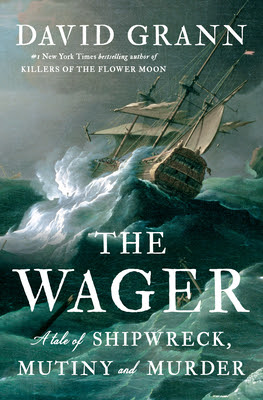
The Wager by David Grann

Cool Bloggers Book Club reminder: If you want to vote for the book we're going to read next month, please vote! You can vote in the comments section of Monday's post or send me an email via the form on the sidebar.  The voting is tight so EVERY VOTE COUNTS. 

****************

I feel like someone in Bloglandia (was it you?) said that they were going to buy their dad a copy of The Wager: A Tale of Shipwreck, Mutiny and Murder by David Grann for Christmas and I immediately put a hold on it at the library because if there's one thing I like, it's a tale of a shipwreck. (Not related to books, but my mom and I spent an awesome couple of days at a shipwreck museum in Alpena, Michigan several years ago and those two posts are GOLD in NGS-bingo - postcards, nature walks, and a scavenger hunt.) 

Minor quibble: Why no Oxford comma in your subtitle, David Grann?

I read Killers of the Flower Moon by this same author in 2022 and I found it important, but sort of boring and hard to follow, so I was nervous that somehow Grann would mess this up, but how could he mess up a dramatic shipwreck narrative?

Friends, he did NOT mess this up. In the prologue to the book (within the first two pages), Grann tells us that in 1740, during a conflict with Spain, His Majesty's Ship the Wager, a British man-of-war, was believed to have been engulfed by a hurricane and all of its 250 souls on board were lost at sea. But 283 days after the ship had last been seen, eighty-one survivors showed up in Brazil. Six months after that, three additional survivors showed up off the coast of Chile. After those three men recovered, they traveled to England and leveled charges at the first group of eighty-one survivors - that they were mutineers who were guilty of treason.

And this book tells that story! And boy was it a tale. We've got a captain who was running away from family squabbles and debts who believed strongly in a hierarchical structure and rigid adherence to rules and regulations, even when stranded on an unforgiving island. We've got a gunner who is well-respected by the crew and keeps a detailed journal. We've got a young teen midshipman who will (spoiler alert) grow up to become the grandfather to the poet Lord Byron. There are shipwrecks! There's treachery! There's mutiny! There are photographs! There are so many men who don't know how to swim! 

I loved this book. If you want to do yourself a big favor, read In the Heart of the Sea, too, to complete your reading of best shipwreck tales to be put to paper. (Sorry, Moby Dick. I've never read Moby Dick.)

5/5 stars, with just that one note about the Oxford comma in the subtitle

Line of note:

And he [Bulkeley] mentioned one other thing: that Captain Cheap had, "at his own request, tarried behind." (page 198) 

I literally GASPED when I read this. Bulkeley (spoiler alert) was the mastermind behind the mutiny and literally TIED CHEAP up so that he couldn't stop them from leaving. When Bulkeley got to England, he straight up LIED.  

Things I looked up:

Royal George (page 16) - This ship sank while anchored at port in 1782, killing over 800 people. At port! CRAZY. 

Why Greenwich, England? (page 64) - If you read anything about maritime history, you'll quickly learn that latitude (those lines that indicate how far north or south you are) has been figured out for a long time because you can use the stars. However, figuring out the east-west position has not been easy because it relies on being able to keep reliable time and that was hard to do without modern technology because rolling waves would mess with timekeepers that relied on things like pendulums (and gears and the like which still "lose time" to this day).  Anyway, since sailors in the 1700s didn't have modern technology, they relied on a "dead reckoning" - a process using a sandglass to approximate time, and a knotted line dropped in the sea to approximate the ship's speed. (page 65) As you might imagine, this was not particularly accurate.

In modern days, the prime meridian, zero degrees longitude, runs through Greenwich, England. Grann didn't address why, simply adding it as a parenthetical. The answer is actually pretty straightforward. There's a big astronomical observatory there and it's been there since 1675 (as an American, this seems unbelievable!). When there was a an International Meridian Conference in 1884 (ha ha! doesn't that sound like a good time?), Greenwich was selected as prime meridian because of the observatory and because three-quarters of sea charts that were used in shipping commerce were already using Greenwich as prime meridian. The sun never sleeps slept on the British Empire. 

During the shipwreck, "the once orderly crew had devolved into chaos. Most of the men couldn't swim and were engaged in a grim calculus: jump amid the breakers and attempt to make it to shore, or linger as the ship disintegrated." (page 100, bold added by me) 

I went down quite the rabbit hole on this one. Apparently a lot of sailors couldn't swim because of quite a few reasons. First, it was thought that if you fell off the ship, you were as good as dead, so why bother learning? Second, many people in the British navy were press-ganged and never had the opportunity to learn to swim AND the navy liked it that way because that meant these forced-to-be sailors couldn't swim to escape. Also, in many places, there's no place to practice swimming and/or there's no leisure time for such recreation. Even today, over half of Americans (including me!) cannot swim well enough to save themselves.  

I like to think that if I were a professional seafaring person, I would rectify this situation, but who am I to say?

thorn-tailed rayaditos (page 111) - common and noisy bird found in temperate forests of Argentina and Chile

It's so cute!


Kawésqar and their dogs (page 124) - The Kawésqar were an indigenous people who live in Chilean Patagonia. They used to be a nomadic seafaring people and were sometimes called canoe-people.  Their territory spanned hundred of miles along the coastline of Chile. Could you even imagine being entirely based on sea?! They made canoes that were eight to nine meters long and one meter wide. This canoe had enough room to transport a family and its prized dogs, which served as night guards, hunting companions, and heat-bearing pets. 

More evidence, if it was even needed, to point out that dogs are integral members of the family. Imagine that you give up room in your canoe home to a dog!! I mean, I would, but Hannah would inevitably overturn the canoe and kill us all. 

guanaco (page 193) - mammals related to camels found in South America (note: super cute)

Source

Hat mentions (why hats?):

So many hat mentions! I counted fifteen, but I was so engrossed in the narrative that it's possible I missed some. The most poignant:

As he departed, he lost his hat in a gust of wind. The seaman John Duck walked over to his old companion and generously gave him his own hat.
Byron was overcome by this flash of kindness. "John!" he exclaimed. "I thank you." But insisting he could not leave Duck without a hat, he returned it. (page 176)

Tuesday, December 12, 2023

The Comeback by Lily Chu

I read The Stand-In by Lily Chu earlier this year and gave it 5/5 stars, so I was a bit apprehensive going into The Comeback that she would let me down. Let's see how it shook out. 


ALERT! ALERT! There is a HAT on the cover. HAT ALERT.

Ariadne Hui is a lawyer because her father wanted her to be a lawyer. She thrives on routine and if she's going to make partner at her law firm, she has to to things a certain way. Her roommate is out of town and forgets to tell Ariadne that her cousin Jihoon will be staying in her room, so one day Ariadne comes home from work to find a gorgeous guy sleeping on her couch. Apparently he's visiting from Seoul after a tough breakup, so he's going to be Ariadne's roommate for a bit. 

But Jihoon is not exactly who he said he was. And when the truth comes out, all of Ari's carefully laid plans may just fall apart. 

Interesting characters: I mean, look, who even cares about Jihoon. He seems too good to be true. I am Ari and Ari is me. We both think we should be doing something spectacular with our lives when what really makes us happy is something entirely different. Ari is relatable, hilarious, and I want to give her a big hug and a Prozac. 

Believable conflict: I mean, look, the basic premise of this book is insane and unbelievable. But if it WERE true, this conflict is 1000% going to happen. 

Emotional tension: Oh, for sure. There were a lot of false starts for these two and for legitimate reasons. I actually thought for a brief moment that they would end up not getting together again, especially when months went by and it was like New Moon up in there. (If you do not understand that reference, GOOD FOR YOU. Your life is better off this way.)

Happily ever after: For Ari, for sure. She's doing something she loves and has made real progress in dealing with her emotions. For Jihoon, hmmm. Well, he seems happy. Will they stay together forever? I don't know, but they seem happy right now. 

5/5 stars mostly because I laughed so hard during this book and really felt like Ari might be the most relatable character I've ever read in a romance novel. 

Lines of note:

I check Jihoon's room to make sure he's out before hunting through my playlist for the perfect song to motivate me for the day. "Paradise City" blares into the quiet apartment seconds later.

That's the stuff. I start slow but am soon scream singing my frustrations into a wooden spoon snatched off the counter as I fill the kettle and pop it on the stove to boil, full-on Axl Rose-ing it with high kicks around the kitchen before standing with my legs jabbing upward...I'm in the middle of channeling Slash with my spoon-cum-air-guitar as I beg the cup on the counter to take me home, yeah-yeah, when I attempt a complicated jump turn and nearly knock over Jihoon, who is standing behind me. (page 29-30)

LOLOLOLOL. *sob* The actual number of times my husband has found me dancing to GNR is non-zero. 

Really, the entirety of Chapter Four is some of the most hilarious writing I've come across in years. I was literally CRYING with laughter at this scene. 

I wouldn't be surprised if Hospital Waiting Room is one of the featured tortures of Hell, and they wouldn't even have to change the seating. (page 38)

Yes! Good observation, Ariadne. 

Again with my name. I didn't think I needed validation this much, but every time he's said it tonight, I had a warm sense of being seen. (page 50)

AND

I never felt any particular way about my name, but when Jihoon says it, it's like a caress. (page 75)

THIS IS ME. When a normal person says my name, it's whatever. But when my husband says my name? I melt into the floor.

I have to work tomorrow and the next day and the next and every day until I die. (page 51)

LOLOL. Catch me after a hard Wednesday and I am this same way. 

Idol. It blows my mind that's even a real job title, but professional nomenclature is not the apex issue of my problem pyramid. (page 152-153)

MY PROBLEM PYRAMID. I died. 

This gives me plenty of time to lie on the couch and think big thoughts, which include but are not limited to:
    My career, which is in tatters and I should attend to posthaste.
    My reputation, now trashed...
    New apartments I should be viewing and don't want to.
    ...
    Climate change, an enormous problem I contribute to by existing. (page 349)

If you've never collapsed on the couch and considered the repercussions of your own existence on Planet Earth, you will never understand me or Ariadne. 

Hat mentions:

SIXTEEN hat mentions because we have people trying to hide from the press. Brim of his hat, mask and hat, sunglasses and hats, bucket hats. We've got it all. 

Is this phrase a thing?

My parents are not the kind to have a wine cabinet, especially since Mom goes maroon after half a glass of chardonnay. (page 112) (italics added by me)

****************

Lily Chu is now an immediate must-read for me. TWO five star reads in a row?! Yes, please, give me more.

Also, hit me up if you've heard this "goes maroon" phrase before. 

Monday, July 11, 2022

Firekeeper's Daughter by Angeline Boulley

Firekeeper's Daughter is Angeline Boulley's debut novel. It's also the 2022 Printz Award winner and it did not disappoint. 

Daunis is a biracial teenager whose birth was a scandal. She doesn't fit in with her white family and since her father's name isn't listed on her birth certificate, she's not enrolled with her indigenous tribe. Daunis does her best, though, muddling through and trying to keep her family together after a series of tragedies. But then she witnesses a murder and soon she's involved in an investigation that could change the entire course of her community.

The Good: I just really liked how Boulley interweaved different aspects of tribal living into day to day life, from the prayers Daunis says before she runs to the pinch of herbs she sacrifices to the river when she's crossing the ferry. I liked how Daunis is clearly a non-native speaker of the language, but she peppers her words with words taken from her indigenous roots. I also liked the Michigan references, because I grew up there and it was fun to hear about Ann Arbor as the "big city" and how people mispronounce Sault Ste. Marie. 

The Great: The writing was riveting. I was really propelled by the writing in this book. Boulley is a bureaucrat (former Director of the Office of Indian Education) and I was a little surprised at how lyrical the prose was here. 

Also, I just loved that Daunis was so competent.  She was smart and used it to her advantage. However, she was also just a regular teenager, making stupid decisions teenagers make and then having to face dire consequences for those decisions. I also really thought Boulley was very brave to tackle so many difficult topics for indigenous peoples - drug and alcohol abuse, tribal enrollment, violence against women, and intergenerational trauma -  but I also felt like it was naturally synthesized into the plot and not just hammered home to make it some sort of morality tale.

The Glorious: I gather that the ending is polarizing. I loved it. I don't want to spoil anything, but the author went in an unexpected direction and I thought it was gorgeously done.

This is easy to read in one way because it's sort of crime thriller, propulsive, turn the page, you have to get to the next chapter kind of book. But it does tackle a lot of challenging issues and, in that way, might be a little harder to read than your average YA thriller.  Regardless, I highly recommend this and if you get a chance to read it, you won't regret it.

5/5 stars

Lines of note:

Part of me wants to be in bed with my cat, Herri, whose purrs are the opposite of an alarm clock.  (page 6)
This is me every moment of every day.  I'd almost always rather be on the couch with my cat.

"My girl, some boats are for the river and some are for the ocean."
I think Granny June is right. I just don't know which one I am. (page 14)
I really liked how Boulley wrote this so that you really feel how torn Daunis is between worlds.

When someone dies, everything about them becomes past tense. Except for the grief. Grief stays in the present. (page 24)
And so it is.

"Even inaction is a powerful choice." (page 394)
This line resonates hard right now with the cavalcade of terrible SCOTUS decisions coming down and watching democracy crumble right personal liberty at a time.

Curiosity killed the cat. Doubt tore her to pieces. (page 396)
Preach.

Monday, June 20, 2022

A Wizard's Guide to Defensive Baking by T. Kingfisher

A Wizard's Guide to Defensive Baking is the tale of Mona, a fourteen-year-old girl who has a magical way with dough and baked goods. She finds a dead body in her aunt's bakery, is accused of the murder, and then proceeds to become an integral part of defending her government against an attempted coup.  But Mona never asked to be a hero.

T. Kingfisher is the pen name for Ursula Vernon, who writes children's books and comics. When she writes something that's a little unusual or a little dark or just doesn't fit the idea of what her Vernon persona would write, she publishes under the Kingfisher name. 

From the author's note at the end: Ultimately the problem was that it [A Wizard's Guide to Defensive Baking] was a fairly dark children's book and I, under the name Ursula Vernon, was a write of whimsical upbeat books. If a publisher bought it, they would need me to write about four other books first before they could slip it into the line-up, or else my brand would be in limbo.

I understand that this book has a bit of an edge to it, but I honestly would put this in my pile of sci-fi/fantasy books that make you feel good, like Murderbot and The Wayfarers series. Sure, there are scenes of violence and war, but the main takeaway is that everyone has a gift and everyone's gift is useful.  

Plus, there is a homicidal sourdough starter, killer gingerbread men, and an animate horse corpse.  I mean, what else could you possibly ask for?  I found this book to be extremely entertaining, the worldbuilding was top-notch, and there was plenty of humor. Huge thumbs up from me.  5/5 stars

Lines of note:

Problem was that, like yeast, the thoughts were growing. Pretty soon they'd overflow the edges of my skull, and I wouldn't be able to ignore them any longer. (page 67)

This is exactly how I feel 90% of the time.

Molly understood, though. When you spend most of your time with a dead horse, you learn to respect other people's weird pets. (page 82)

Don't question me about my pets' eccentricities. They're both weird little creatures.

It seemed like once you agreed that the government could put you on a list because of something you were born with, you were asking for trouble. (page 128)

This cuts too close to home.

If you have ever prepared for a siege in two days, than you know what the next few days were like. If you haven't, then you probably don't. (page 212)

I like this way to handwave doing exposition.  The author clearly wanted to show time had passed, but didn't want to go into excruciating detail about preparations. This was done with humor and I liked it. 

It is nearly impossible to be sad when eating a blueberry muffin. I'm pretty sure that's a scientific fact. (page 238)

True fact.

Monday, June 13, 2022

Leviathan Falls (The Expanse #9) by James S. A. Corey

Leviathan Falls is the ninth and final book in The Expanse series. It was a fitting final novel to one of the best science-fiction series I have ever read. This book is action-packed and filled with great interactions between our characters, the wry wit Corey are known for, and it introduces a dog, so you know I'm on board for that.  

It's very hard to know what to write without giving away major spoilers, but in the first book of the series, Leviathan Wakes, we are introduced to an alien life form and in this book, we see how humans eventually deal with that.  It's a lovely story of aging, dealing with existential questions of purpose of life and mundane questions about how dogs defecate in space. It's a brilliant look at how relationships morph, develop, and strengthen and weaken over time. 

If I haven't convinced you to read these books yet, I don't know what else I can do. This writing duo can do no wrong, as far as I'm concerned, and I can't wait to see what they do next.  This series is as great a science-fiction series as I have ever read. 5/5 very enthusiastic thumbs up.

Lines of note:

When Alex talked about his grandson, working out whether he'd been born yet, how big he was likely to be, speculating on the names that Kit and his wife might choose, all Jim could see was one more body on the pile when the end came. Another baby who'd stop breathing when the deep enemy solved its puzzle. Another death.

Maybe that was unfair. There had been any number of end-times before this: black plague, nuclear war, food web collapse, Eros moving. Every generation had its apocalypse. If they made humans stop falling in love and having babies, celebrating and dreaming and living out the time they had, they'd have stopped a long time before. (page 74)

There are a number of reasons my husband I don't have children, but the fact that our country has essentially been at war our entire adult lives definitely played a factor into our decision. Bringing children into a world in which climate change, war, and the threat of nuclear annihilation (and that was before I worried about a never-ending pandemic) seemed unfair. I think parents are very brave.

"If mitochondria and chloroplasts hadn't set up shop inside other organisms, eukaryotic life wouldn't exist, including all of us. Hermit crabs using discarded shells and soup cans. Acacia ants built their whole evolutionary strategy out of supporting trees. Intestinal microflora have a vast effect on cognition, emotion, metabolism. Most of the cells in your body right now aren't human. Change out a few species of bacteria in your gut, and you'll be a fundamentally different person." (page 321)

My husband has challenging gut issues and we've seriously looked into a fecal transplant, but this very idea that his personality could change entirely has prevented us from going through with it. 

"Did something happen with Elvi?"
...
"Have you asked her?"
"You see? There you go with your useful, straightforward suggestions. I never come up with those kinds of things myself." (pages 347-348)

It's this kind of interaction between characters that makes me love this series so much.

"It was like seeing a Picasso composition in the style of Van Gogh, familiar and alien at the same time." (page 356)

I love a good simile. Simply brilliant writing from Corey here. 

"You want bullshit happy mouth noises, or the truth."
"Bullshit happy mouth noises."
"It's great," Miller said without missing a beat. "It's having a long, restful sleep full of interesting, vivid dreams." (page 452)

This is absolute fan service here. In the final pages of the novel, Corey brings back an OG character and has the dialogue be spot on in his voice. 

Again, if you're not reading this series, you're missing out on something great. 

Friday, June 10, 2022

Penric's Progress by Lois McMaster Bujold (World of Five Gods, Penric & Desdemona #1-3)

Okay, I am still quite confused about the reading order for the World of Five Gods saga by Lois McMaster Bujold. I messed up with the first trilogy and it looks like I might have messed up this sub-series within the greater world.  Sheesh.  I am pretty sure you're supposed to read the following books in the following order to start the saga:


After that, things start to get a little dicey. There's a sub-series called Penric & Desdemona and I took out Penric's Progress from the library because I thought it was the first three novellas in the sub-series, but it looks like there's a fourth novella that isn't actually captured in this collection.  Why is this so confusing?  


So, regardless if I'm doing it correctly or not, this collection contains the novellas "Penric's Demon," "Penric and the Shaman," and "Penric's Fox." In the first novella, we're introduced to Penric, the third born son of a poor nobleman. On the way to his betrothal ceremony, he goes to the assistance of an ailing lady and as she dies, it turns out that she's a Temple Divine and she bequeaths her demon to Penric.  Penric names the demon Desdemona and soon we're off on adventures of Penric and his demon.

In "Penric and the Shaman," Penric is on the hunt for a shaman who has been accused of murder and in "Penric's Fox," a Temple Divine is murdered and Penric must find her demon.  These stories are simply brilliant - Bujold has built a wonderful world and it's so very immersive. And Penric is joyful and smart and funny. The whole series has an irreverent humor to it that is so very rare to find in epic fantasy stories that tend to take themselves seriously.

I just love the World of Five Gods. 5/5 stars for this one, too.

Lines of note:
The man could certainly put the grim in grimace. (page 36)

"For all that we trust the gods, I think we can trust them to know the difference between humor and blasphemy." (page 191)

"It was a revelation. Trees had leaves. And letters were not elusive fur-bearing creatures hiding coyly behind each other. I wasn't stupid, I just couldn't see." (page 220)

Wednesday, April 27, 2022

The Flatshare by Beth O'Leary

The Flatshare is Beth O'Leary's debut novel. I loved The Switch, so I was excited to dive in and see what else she could do.

Tiffy has just broken up with her jerk of an ex-boyfriend. She works at publishing house for very little money at a job she loves, so when she sees an ad for a flatshare where she could stay in an apartment from 6pm to 8am during the week and all of the weekends for a bargain basement price, she can't resist. She moves in to the apartment without meeting the "day tenant," Leon, and they soon begin exchanging notes.

Interesting characters: Oh, yes, so much! I want to be friends with all of them, from Tiffy to Leon to all of Leon's patients to Tiffy's friends to Leon's brother. I do not want to be friends with her terrible ex-boyfriend, but he was a well-written ex.  I was just charmed by all of them. 

Believable conflict: Oh, yes. Past trauma on both their parts leads to absolutely recognizable conflict. It was very well done. It was great to see the two main characters communicate about their issues in a mature manner, too. I really liked how Tiffy had her friends and Leon had his brother as sounding boards for their relationships and how realistic and fun those scenes were. It was so great to see women and men with such solid same-sex friendships. 

Emotional tension: Oh, this was so well done. They didn't actually even see each other until a third of the way in and O'Leary did a good job of maintaining the sexual tension all the way until the end. Since they were both dealing with some stuff, it made sense that things wouldn't be smooth for them, but it all seemed real.

Happily ever after: Oh, so cute. The end was so cute and wonderful!

In case you can't tell, I loved this book. I adored it and now I must read the rest of her books. She's only released four as of right now, but I shall be reading the two I haven't read ASAP.

5/5 stars

Wednesday, February 02, 2022

The Final Revival of Opal & Nev by Dawnie Walton

 The Final Revival of Opal & Nev by Dawnie Walton is the fictionalized oral history of an iconic interracial rock duo made up of a British dude and a badass from Detroit. 

When I first started reading this, I was immediately reminded of Daisy Jones & The Six by Taylor Jenkins Reid. Rock and roll, drugs, the ampersand in the title, the entire framing structure of an oral history, the journalist with a familial tie-in to the story - the parallels are there and the parallels are strong. But while there are a lot of similarities, the characters of Daisy and Opal are so different that you soon forget about all the likenesses and move right along with the compelling narrative.

What I really appreciated about this book was its seamless integration of historical details with the main story. Opal and Nev are listed right alongside other real acts of the time period, Opal discusses real current events, and it all makes it seem as if you're reading a real oral history, not a fictional one. The book begins with a fictional "editor's note" and just keeps going all the way to the end.

There are so many aspects of the novel that were just so well done. It's an important look at the developments, or lack thereof, in race relations in the United States, and this book does that by integrating Opal's experiences in Detroit in the 60s and 70s (her description of staying huddled up with her sister and mother during the riots in 1967 was harrowing) to her reaction to the current BLM and MeToo movements.  It also raises very important questions about what the role of allies is and what the responsibilities of allyship are. Honestly, as a white person reading this book, I wondered a lot about Nev's role and what he could have done to make things easier for Opal in a way that Opal wouldn't have found insulting. (I mean, there are one or two BIG things he SHOULD have done and I think the reader will know what those are when they come up, but in day to day, what could or should Nev have done differently?)

The last thing I want to rave about here is Walton's writing. It's so good. She's writing dozens of people, in their voices, and she just does it so well. There's no wondering if Opal, Rosemary, or Chet is speaking because they all have unique voices. I am not a writer and I have no idea how this is technically done, but it was absolutely refreshing to have an author code switch so effectively and impeccably.  

Notable Lines:

"That's what the South was like for me. Sweet on the first taste, but something gone sour underneath. It'll try to trick you, now - the sugarberries and the quiet and those lovely spread-out homes. But after that day with Auntie Rose, I could smell the rotten too." (page 18-19)

I've traveled in the Southern United States a few times and I love the food and the architecture, but I'm always kind of on edge waiting for some sort of violence to break out. It doesn't make sense - I live within an hour's drive of Milwaukee, a very segregated city with tense race relations - but there you have it. 

"Survival skills. Some of us have them; some of us don't...I'm not talking about blaming victims. I'm just saying that some of us are naturally stronger, better equipped to deal with the bullshit than others, and that's the same as saying that some people are taller than others. Just fact, no judgment. And for those who are going through the tough ties and don't have that kind of strength already? Well, that's all right, because trust me: It can be learned." (page 38)

This is quite encouraging, in its own way. Some real growth mindset stuff here.

"...we got a Butterick Fast & Easy pattern that I nearly tore to shreds because it was so difficult." (page 93)

I have a "Fast & Easy" pattern I've been working on for about a year. Ha!

"Anyone who says they're color-blind is a damn lie. But there is plenty of time between what you see and what you say. And their little comments, their trying to talk Black or whatever, to me that was the going out of their way to announce they were cool with me being there, cool with me participating in what they obviously believed was their scene." (page 117)

When I taught American Minority Politics, students would regularly use their "color-blind" bullshit with me and I would call them on it.  It's not noticing race that's the problem, it's using it to change your thoughts and actions.

"When you talk about challenging to absorb, so is Bob Dylan's whiny ass, in my opinion, and that fucking Ulysses book I had to read in college. Nigga, what? But aren't we supposed to better and smart because of the challenging art that makes us uncomfortable? Isn't the culture better for it? Or does that only apply when heterosexual cisgender white men do the challenging?" (page 336)

This is a great encapsulation of why art matters and makes the world a better place to be.

Things I Looked Up:

Reverend Fred Shuttlesworth (page 17): A civil rights activist in Birmingham, Alabama and co-founded SCLC. He worked with MLK, although the two sometimes disagreed on tactics and strategies.

Panto (page 27) - Informal, British abbreviation of pantomime. 

Brummie boy (page 45) - I think this is also British slang for a man/boy from Birmingham, although I'll take corrections on this.

Angela Davis and George Jackson (page 106) - This is a sad, sad tale. George Jackson was an innocent man sent to jail and he and Angela Davis shared a relationship via letters. Jackson became more and more radicalized the longer he was in jail and eventually Davis smuggled weapons that were used in a courthouse hostage situation. Jackson tried to escape San Quentin prison and was shot and killed in that attempt. (There's a great Ear Hustle episode on George Jackson that I remembered listening to as I started reading more about this.)

Toulouse - Lautrec sketch (page 214) - Henrie Marie Raymond de Toulouse-Lautrec Monfa "is known along with Cezanne, van Gogh, and Gaugin as one of the greatest painters of the Post-Impressionist period." I mean, I got that straight from an article from the Toulouse-Lautrec Foundation, so make of that what you will.  (Not related: He had some sort of disability/genetic disorder that he didn't grow very tall and he wasn't able to really do much physical activity, so that's why he immersed himself in art so much.)


George Wallace got shot (page 252-253) - I am familiar with George Wallace, the Alabama governor who proclaimed "segregation today, segregation tomorrow, segregation forever." I did not know, however, that he was shot in 1972 while he was campaigning for the presidential nomination and that this left him paralyzed for the rest of his life. He also suffered from Parkinson's in his later years. I have no idea how I didn't know this, but my husband didn't either, so that makes me feels somewhat less uneducated.

Pat Cleveland (page 276) - An African-American fashion model in the 1960s and 1970s. 

Melissa Harris-Perry (page 318) - A mixed race TV host/political commentator who hosted a weekend morning show on MSNBC from 2012-2016, when she left the network in an acrimonious manner.

Wait on line (page 332) - This is the third or fourth time that this phrase has come in my life recently, so I looked it up. Waiting in line (this is what I would say) is much more common that waiting on line, which is a phrase mostly found in the area of NYC. They mean the same thing.

You guys, I loved this book. 5/5 stars