Cool Bloggers Book Club reminder: If you want to vote for the book we're going to read next month, please vote! You can vote in the comments section of Monday's post or send me an email via the form on the sidebar. The voting is tight so EVERY VOTE COUNTS.
****************
I feel like someone in Bloglandia (was it you?) said that they were going to buy their dad a copy of The Wager: A Tale of Shipwreck, Mutiny and Murder by David Grann for Christmas and I immediately put a hold on it at the library because if there's one thing I like, it's a tale of a shipwreck. (Not related to books, but my mom and I spent an awesome couple of days at a shipwreck museum in Alpena, Michigan several years ago and those two posts are GOLD in NGS-bingo - postcards, nature walks, and a scavenger hunt.)
Minor quibble: Why no Oxford comma in your subtitle, David Grann?
I read Killers of the Flower Moon by this same author in 2022 and I found it important, but sort of boring and hard to follow, so I was nervous that somehow Grann would mess this up, but how could he mess up a dramatic shipwreck narrative?
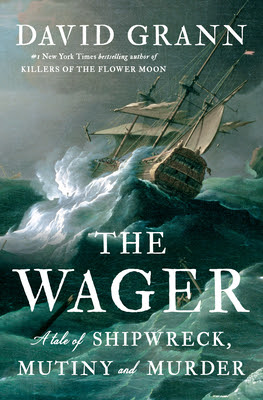
Friends, he did NOT mess this up. In the prologue to the book (within the first two pages), Grann tells us that in 1740, during a conflict with Spain, His Majesty's Ship the Wager, a British man-of-war, was believed to have been engulfed by a hurricane and all of its 250 souls on board were lost at sea. But 283 days after the ship had last been seen, eighty-one survivors showed up in Brazil. Six months after that, three additional survivors showed up off the coast of Chile. After those three men recovered, they traveled to England and leveled charges at the first group of eighty-one survivors - that they were mutineers who were guilty of treason.
And this book tells that story! And boy was it a tale. We've got a captain who was running away from family squabbles and debts who believed strongly in a hierarchical structure and rigid adherence to rules and regulations, even when stranded on an unforgiving island. We've got a gunner who is well-respected by the crew and keeps a detailed journal. We've got a young teen midshipman who will (spoiler alert) grow up to become the grandfather to the poet Lord Byron. There are shipwrecks! There's treachery! There's mutiny! There are photographs! There are so many men who don't know how to swim!
I loved this book. If you want to do yourself a big favor, read In the Heart of the Sea, too, to complete your reading of best shipwreck tales to be put to paper. (Sorry, Moby Dick. I've never read Moby Dick.)
5/5 stars, with just that one note about the Oxford comma in the subtitle
Line of note:
And he [Bulkeley] mentioned one other thing: that Captain Cheap had, "at his own request, tarried behind." (page 198)
I literally GASPED when I read this. Bulkeley (spoiler alert) was the mastermind behind the mutiny and literally TIED CHEAP up so that he couldn't stop them from leaving. When Bulkeley got to England, he straight up LIED.
Things I looked up:
Royal George (page 16) - This ship sank while anchored at port in 1782, killing over 800 people. At port! CRAZY.
Why Greenwich, England? (page 64) - If you read anything about maritime history, you'll quickly learn that latitude (those lines that indicate how far north or south you are) has been figured out for a long time because you can use the stars. However, figuring out the east-west position has not been easy because it relies on being able to keep reliable time and that was hard to do without modern technology because rolling waves would mess with timekeepers that relied on things like pendulums (and gears and the like which still "lose time" to this day). Anyway, since sailors in the 1700s didn't have modern technology, they relied on a "dead reckoning" - a process using a sandglass to approximate time, and a knotted line dropped in the sea to approximate the ship's speed. (page 65) As you might imagine, this was not particularly accurate.
In modern days, the prime meridian, zero degrees longitude, runs through Greenwich, England. Grann didn't address why, simply adding it as a parenthetical. The answer is actually pretty straightforward. There's a big astronomical observatory there and it's been there since 1675 (as an American, this seems unbelievable!). When there was a an International Meridian Conference in 1884 (ha ha! doesn't that sound like a good time?), Greenwich was selected as prime meridian because of the observatory and because three-quarters of sea charts that were used in shipping commerce were already using Greenwich as prime meridian. The sun never sleeps slept on the British Empire.
During the shipwreck, "the once orderly crew had devolved into chaos. Most of the men couldn't swim and were engaged in a grim calculus: jump amid the breakers and attempt to make it to shore, or linger as the ship disintegrated." (page 100, bold added by me)
I went down quite the rabbit hole on this one. Apparently a lot of sailors couldn't swim because of quite a few reasons. First, it was thought that if you fell off the ship, you were as good as dead, so why bother learning? Second, many people in the British navy were press-ganged and never had the opportunity to learn to swim AND the navy liked it that way because that meant these forced-to-be sailors couldn't swim to escape. Also, in many places, there's no place to practice swimming and/or there's no leisure time for such recreation. Even today, over half of Americans (including me!) cannot swim well enough to save themselves.
I like to think that if I were a professional seafaring person, I would rectify this situation, but who am I to say?
thorn-tailed rayaditos (page 111) - common and noisy bird found in temperate forests of Argentina and Chile
 |
| It's so cute! |
More evidence, if it was even needed, to point out that dogs are integral members of the family. Imagine that you give up room in your canoe home to a dog!! I mean, I would, but Hannah would inevitably overturn the canoe and kill us all.
guanaco (page 193) - mammals related to camels found in South America (note: super cute)
 |
| Source |
Hat mentions (why hats?):
So many hat mentions! I counted fifteen, but I was so engrossed in the narrative that it's possible I missed some. The most poignant:
Byron was overcome by this flash of kindness. "John!" he exclaimed. "I thank you." But insisting he could not leave Duck without a hat, he returned it. (page 176)

